Asked for a “HAZMAT Certificate”? Make sure you take the right course
Crewing teams and seafarers often ask the same question:
Do I need IMO Model Course 1.10, Model Course 1.45, or both?
The answer depends mainly on how the cargo is carried:
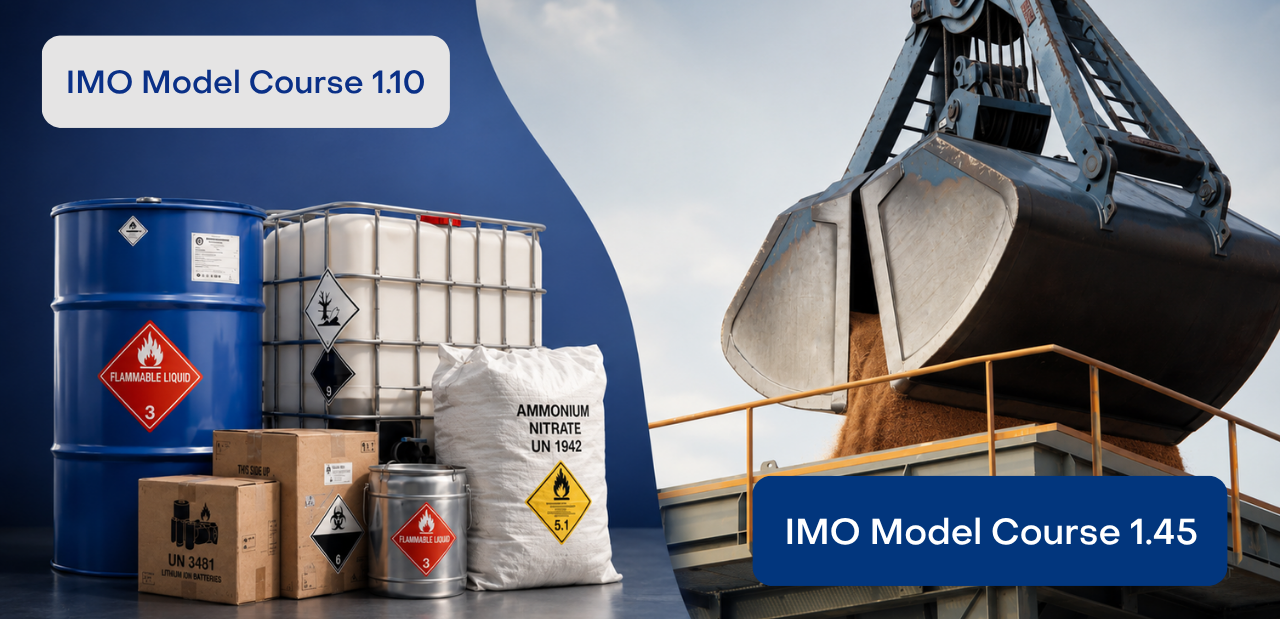
- IMO Model Course 1.10 applies to dangerous goods carried in packaged form.
- IMO Model Course 1.45 applies to solid cargoes carried loose in bulk.
- A person whose duties cover both types of cargo may need both courses.
The vessel type alone does not give the answer. The important points are the cargo form, the person’s duties, and the requirements of the flag State, company or client.
The basic difference
The term “dry cargo” is very broad. It can include coal loaded loose into a cargo hold, dangerous goods packed in containers, grain carried in bulk, and many other cargoes.
These cargoes do not all follow the same rules.
| IMO Model Course 1.10 | IMO Model Course 1.45 | |
|---|---|---|
| Course title | Dangerous, Hazardous and Harmful Cargoes | Safe Handling and Transport of Solid Bulk Cargoes |
| Cargo form | Dangerous goods in packages or cargo transport units | Solid cargo loaded loose in bulk |
| Main code | IMDG Code | IMSBC Code |
| Examples | Dangerous goods in containers, drums, bags, cylinders, IBCs or portable tanks | Coal, mineral concentrates, iron ore fines, nickel ore, sulphur and bulk fertilizers |
| Main topics | Classification, labels, documents, stowage, segregation and emergencies | Cargo information, IMSBC groups, liquefaction, chemical hazards, loading and discharge |
The easiest rule to remember is:
Packaged dangerous goods: Model Course 1.10. Solid bulk cargoes: Model Course 1.45.
IMO Model Course 1.10: packaged dangerous goods
Model Course 1.10 is for personnel responsible for dangerous goods carried in packaged form under the IMDG Code.
The package may be a box, drum, bag, cylinder, intermediate bulk container, freight container or portable tank. The product may be a solid, liquid or gas. What matters is that it is carried as packaged dangerous goods.
The course normally covers:
- dangerous-goods classes and identification;
- marks, labels and placards;
- dangerous-goods documents;
- packing and tank requirements;
- stowage, securing and segregation; and
- emergency action.
This training may be relevant to masters, deck officers, ratings with dangerous-goods duties, cargo planners and other shore personnel involved in IMDG operations.
However, not every person on a container ship automatically needs the certificate. The company should check the person’s actual duties and the requirements for the assignment.
IMO Model Course 1.45: solid bulk cargoes
Model Course 1.45 is for personnel involved in the safe handling and transport of solid cargoes loaded loose into the ship’s cargo spaces. It is based mainly on the IMSBC Code.
Solid bulk cargoes can create several hazards. These include liquefaction, loss of stability, structural damage, fire, toxic gas and oxygen depletion.
The course normally covers:
- use of the IMSBC Code and cargo schedules;
- cargo information and acceptance;
- IMSBC Groups A, B, A and B, and C;
- moisture content, transportable moisture limit and liquefaction;
- cargo distribution, stability and structural loading;
- hold preparation, loading, trimming and discharge; and
- ventilation, atmosphere monitoring and emergency precautions.
This training may be relevant to masters, chief mates, deck officers, ratings with bulk-cargo duties, marine superintendents, terminal staff, shippers and other personnel involved in solid bulk cargo operations.
Again, the requirement should be based on the person’s duties. A crew member should not be assigned the course only because the vessel is a bulk carrier.
A dangerous solid does not always mean Model Course 1.10
The word “dangerous” can cause confusion.
- A dangerous solid carried loose in bulk normally falls under the IMSBC Code and points to Model Course 1.45.
- A dangerous product carried in a package or cargo transport unit normally falls under the IMDG Code and points to Model Course 1.10.
An intermediate bulk container, or IBC, is still a type of packaging. It is not the same as loading a solid cargo loose into a ship’s hold.
Practical examples
| Cargo or assignment | Normally relevant course |
|---|---|
| Coal loaded loose in a bulk carrier’s holds | Model Course 1.45 |
| Nickel ore or iron ore fines loaded in bulk | Model Course 1.45 |
| Dangerous goods carried in freight containers | Model Course 1.10 |
| Dangerous goods carried in drums or bags | Model Course 1.10 |
| A ship carrying solid bulk cargo and packaged dangerous goods | Both may be required for responsible personnel |
| Non-dangerous packaged general cargo only | Neither course is required automatically because of cargo type alone |
| Grain carried in bulk | Check the International Grain Code and company requirements separately |
Grain needs special attention. The IMSBC Code does not cover grain in bulk. The International Grain Code provides the main requirements for its safe carriage.
Are these mandatory STCW certificates?
This is where many people become confused.
STCW requires deck officers to have cargo-handling competence, including knowledge of dangerous, hazardous and harmful cargoes. STCW sections B-V/b and B-V/c also provide guidance for personnel responsible for solid bulk cargoes and packaged dangerous goods.
However, these sections are in Part B of the STCW Code, which provides recommended guidance. Therefore, Model Course 1.10 and Model Course 1.45 should not be described as universal STCW Certificates of Proficiency required for every seafarer.
Formal course certificates may still be required by:
- the flag State or national law;
- the company’s Safety Management System or training matrix;
- the shipowner or manager;
- a charterer, cargo owner or terminal;
- a vetting or inspection programme; or
- the seafarer’s contract or job requirements.
Crewing teams should therefore check both competence and documentary requirements for the specific vessel and assignment.
What does RightShip RISQ 3.2 require?
RightShip RISQ 3.2, dated November 2025, makes the distinction clear for vessels within its inspection scope.
- Personnel responsible for dangerous and hazardous substances carried in solid form in bulk should have formal training aligned with Model Course 1.45.
- Personnel responsible for dangerous and hazardous substances carried in packaged form should have formal training aligned with Model Course 1.10.
RISQ accepts classroom, online and computer-based training. The training should have a defined syllabus, clear learning objectives, an assessment and a certificate after successful completion.
This is an industry inspection requirement. It is not a new STCW endorsement.
What should a crewing operator check?
Before accepting a certificate, check:
- the seafarer’s name;
- the full course title;
- the correct model-course reference: 1.10 or 1.45;
- the relevant code: IMDG or IMSBC;
- confirmation that the trainee passed an assessment;
- the training provider and issue date; and
- any flag, company, charterer or vetting requirements.
IMO does not issue the individual certificate. The training provider issues it. The company must decide whether the certificate is acceptable for the intended assignment.
There is also no general five-year renewal rule that applies simply because a certificate refers to Model Course 1.10 or 1.45. Check the flag requirements, company training matrix, provider terms and client requirements.
Can one certificate cover both courses?
Possibly, but a general title such as “dangerous cargo training” is not enough.
A combined course should clearly cover both the IMDG and IMSBC subjects, assess both parts, and show the correct course references on the certificate. If this is not clear, do not assume that one certificate covers both courses.
A simple decision guide
Ask these questions:
- Is the cargo a solid loaded loose in bulk? Check Model Course 1.45.
- Is it a dangerous good carried in a package or cargo transport unit? Check Model Course 1.10.
- Does the person plan, supervise, monitor or handle that cargo? Formal training may be required.
- Will the person work with both cargo forms? Both courses may be required.
- What do the flag State, company, charterer and inspection programme require? Check before assignment.
Choose the right Learnmarine course
If your duties involve cargoes loaded loose in bulk, see Learnmarine’s Safe Handling and Transport of Solid Bulk Cargoes course. It is aligned with IMO Model Course 1.45 and the IMSBC Code.
If your duties involve dangerous goods in containers, drums, bags or other packages, see Learnmarine’s Dangerous Goods (HAZMAT) course. It is aligned with IMO Model Course 1.10 and the IMDG Code.
For crewing teams, the main rule is simple: select the course by cargo form, job responsibility and assignment requirements—not only by vessel type.
This article provides general guidance. Always check the current flag-State rules, national law, company procedures and client requirements for the vessel and assignment.
Leave a comment
Be the first to comment.