The Fairplay 22 tug capsize and what it changed in harbour towage
On 11 November 2010, the harbour tug Fairplay 22 was helping the passenger ferry Stena Britannica reach its berth at Hook of Holland, near the entrance to the Port of Rotterdam. The tug came close to the moving ferry’s bow to catch a light line that would be used to pass the heavier towline. Before the towline was secured, the tug struck the ferry’s bow and capsized. The tug’s master and chief engineer died. Three crew members survived. Dutch Safety Board investigation
The investigation showed how quickly a tug can lose room to manoeuvre near a ship’s bow. It also gave ports and towage professionals a case to work from when reviewing how crews agree a safe speed, recognise the forces acting on the tug and train for an approach that has to be abandoned. Investigation report, chapters 4–5 · Report on Safe Tug Procedures
Two attempts to pass the heaving line
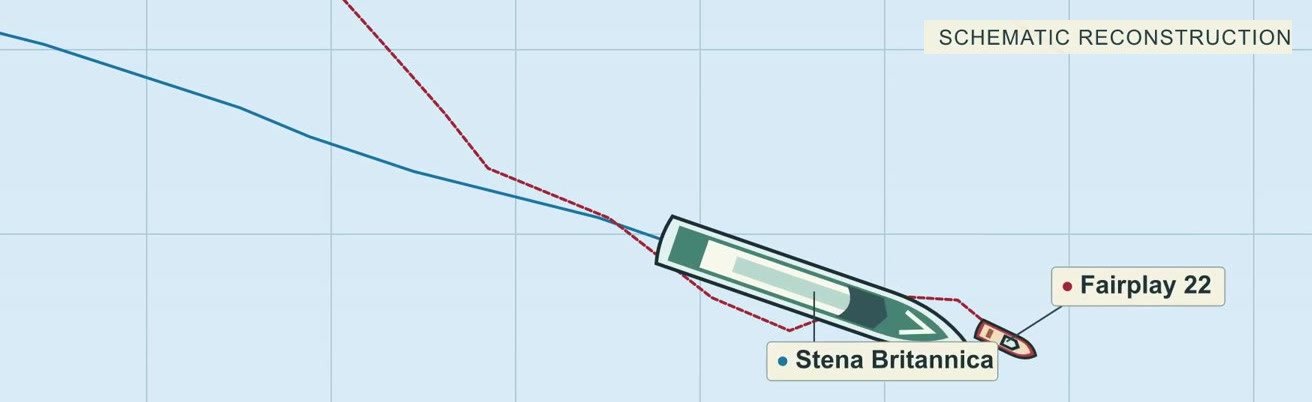
First attempt, around 15:47. The ferry’s chief officer and the tug master agreed over VHF on seven knots through the water. In strong southerly winds, Fairplay 22, an azimuth stern drive (ASD) tug, approached the sheltered port side of the ferry’s bow. At the start of the attempt, the ferry was making about 7.4 knots over the ground and 8.4 knots through the water. The crew failed to pass the heaving line. The tug crossed ahead of the ferry and returned to its port side for another attempt. Dutch Safety Board investigation, §§2.2 and 3.2.1
Second attempt, around 15:49. The ferry had slowed to about seven knots over the ground, but was still making about 7.9 knots through the water against the current. The second transfer also failed. The tug struck the ferry’s bulbous bow below the waterline, swung broadside across the ferry’s path and began to heel. Investigation report, §§3.2.2–3.3
Why the tug could not recover
The Dutch Safety Board identified speed through the water as crucial. Close to a moving ship’s bow, the flow around the hull can push a tug away, draw it in or turn it. Higher speed intensifies those forces and can leave the tug with less power in reserve to move clear. After contact, Fairplay 22 probably had too little power in reserve to escape. Investigators could not determine how much the wind, restricted visibility from the tug’s conning position or reaction time contributed to the collision. Investigation report, §§3.3–3.4 and chapter 4
The collision pushed the tug over. Water could enter through the port engine-room vent at about 35° of heel and through the open aft-deck door at about 73°. Water inside the tug ran to the low side, increasing the heel and accelerating the capsize. The Board found that the tug failed to meet its original 1998 stability requirements with the vents open. Those vents had to stay open to supply air to the running machinery. Routine inspections had accepted the endorsed stability booklet, so they did not detect that shortfall. The tug also fell short of the newer stability criteria the investigators assessed, even with the vents closed. Investigation report, §§3.4–3.5.1
How the lessons reached wider towage practice
Agree and verify speed through the water. Before the casualty, Fairplay’s manual already advised about six knots through the water when taking the heaving line. The Board found that the company had failed to monitor adherence to that guidance. It asked Rotterdam’s harbour master to specify and enforce a maximum connection speed. A Rotterdam working group convened after the casualty surveyed pilots, tug masters and ship masters internationally. Its 2013 report recommended a six-knot maximum when making fast at the bow, with the tug’s capabilities, conditions and the tug master’s experience taken into account. It also called for regular checks that speed limits were being followed. Investigation report, §3.5 and chapter 5 · Report on Safe Tug Procedures, chapters 1 and 7
Make the approach a shared decision. Forth Ports cites Fairplay 22 in its guidance on hydrodynamic interaction. It recommends a maximum of six knots through the water for a forward tug connecting on the ship’s centreline, with lower speeds when conditions call for them. It also calls for the ship’s bridge to confirm the deck crew is ready before the tug closes in, and to tell the tug master about speed or course changes during the connection. UK national good-practice guidance likewise calls for the pilot or ship master to agree speed through the water with the tug master before the operation. Forth Ports Towage Guidelines, §§2.8.1, 3.3.1 and Appendix C · UK Guide to Good Practice on Port and Marine Facilities, §4.6
Why refresher simulator training matters
The ferry master had made more than 1,700 calls at Hook of Holland and had used tug assistance on 167 occasions. His simulator training in 2003 was on the previous Stena Britannica. He had received no local tug-handling training, and the harbour master had not required the three-yearly refresher under its pilotage exemption policy, even when the new ferry entered service. The Board called for tug-assistance competence to be checked when granting pilotage exemptions. The 2013 working group recommended regular refreshers and competency checks for tug masters, and training on the same towage risks for pilots and masters who hold a pilotage exemption. UK port guidance recommends that those groups attend simulator and refresher training together. Investigation report, §§3.5.5–3.5.6 and chapter 5 · Report on Safe Tug Procedures, §§7.1.3–7.1.4 · UK Guide to Good Practice, §4.6
A refresher can put both bridges in the same exercise after a missed heaving line. The instructor can repeat the run at the same speed over ground with a stronger opposing current. A simulator that represents ship–tug interaction for the hulls, speeds and positions involved lets the tug master see how the approach changes, while both teams practise agreeing the speed through the water and deciding when to stand off. In the debrief, check whether the ferry communicated its actual speed, whether the tug recognised it was losing room to move clear, and whether either team called off the approach in time. Report on Safe Tug Procedures, §§7.1.2–7.1.4
Learnmarine’s ASD Handling & Towing course pairs vessel-handling theory with guided practice on a downloadable ASD simulator. Explore the course.
Leave a comment
Be the first to comment.